- calendar_today August 7, 2025
Beyond the Code – How Canadian Creatives Are Using AI Without Losing Their Humanity
Across Canada, Creatives Are Asking the Right Questions First
Canada is a country of contrasts—urban and remote, historic and emerging, soft-spoken and bold. The same can be said of its creative scene. And now, as AI and Canadian culture intersect more and more, artists across the country are figuring out how (and whether) AI belongs in their creative process.
A musician in Ottawa told me, “I used AI once to test tempo variations. It was helpful, sure—but the soul of the song still came from my own late nights and heartbreaks.” That kind of comment comes up often. Artists aren’t rejecting tech, but they’re not handing it the mic either.
Filmmakers Are Letting AI Help—But Only Behind the Scenes
Canadian filmmakers—whether they’re working out of studios in Toronto or shooting vérité docs in the North—are known for their integrity. That’s why most who are using AI in creative work are keeping it strictly on the technical side.
“I used AI to tag my footage for a doc about migration stories,” a filmmaker in Victoria said. “But every emotional decision still came from human hands.” For many, AI is a backstage assistant—not the storyteller, not the star.
In the Studio, Artists Are Testing Tech With a Watchful Eye
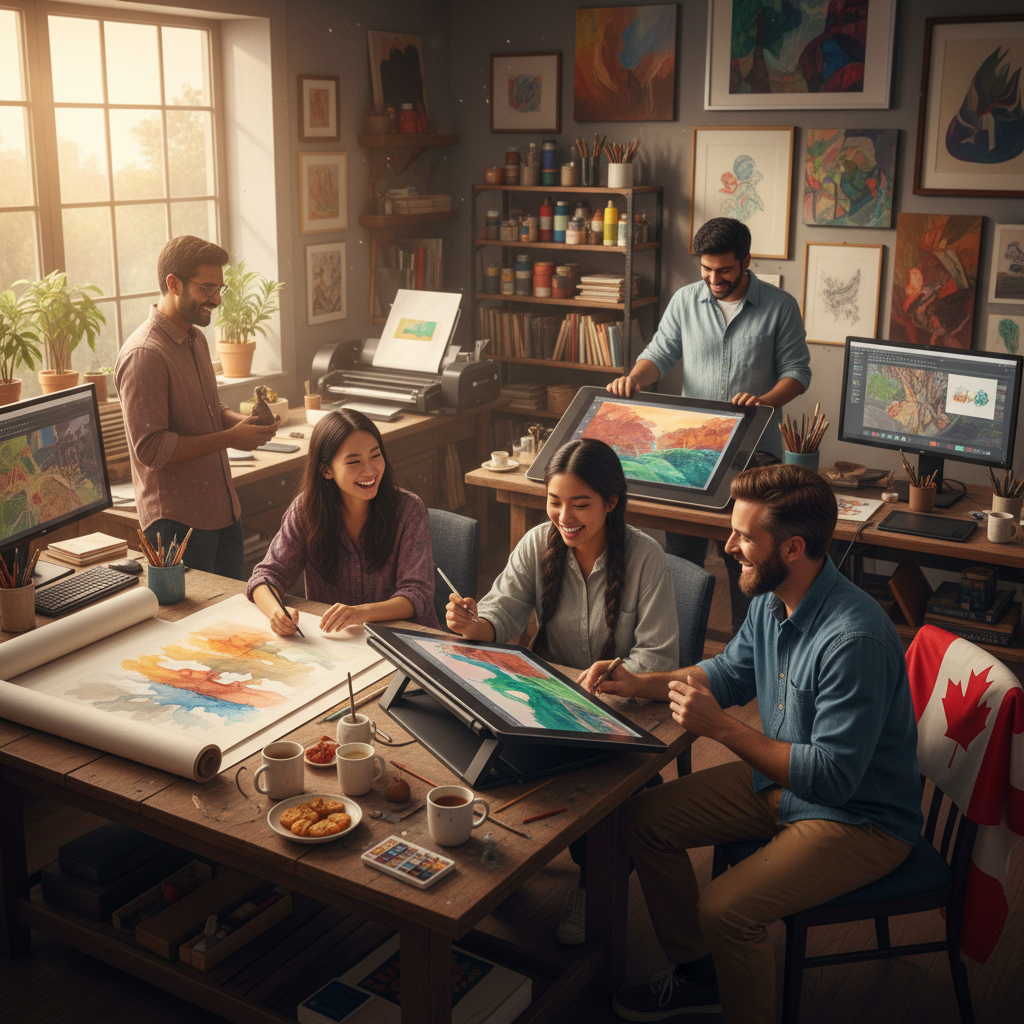
Visual artists from Vancouver to Moncton are starting to test AI and design tools—not to generate final work, but to play with balance, symmetry, or even rhythm. Most still say the emotional or cultural weight of the piece has to come from lived experience.
An artist in Regina shared, “AI helped me reimagine the spacing on a canvas, but the story—about my Métis grandmother—came from family memory, not machine learning.” Across Canada, this balance—between curiosity and care—is shaping how artists use tech.
Students Are Innovating With a Lot of Heart
At art schools and digital programs from coast to coast, students are pushing into Canadian art and technology. They’re building AI-infused theater pieces, creating sound-reactive exhibits, and remixing archive footage through generative tools. But they’re not just playing—they’re processing something deeper.
A student in Halifax told me, “We’re not using AI to be edgy. We’re using it to ask different questions—about memory, about language, about belonging.” That drive to combine tech and emotion, data and identity, is part of what makes Canada’s creative tech scene feel so grounded.
For Indigenous Creators, AI Comes With More Questions Than Answers
Some Indigenous artists across Canada are engaging with AI in powerful, thoughtful ways—especially around language preservation and visual experimentation. But others are staying far away, wary of erasure, appropriation, and disconnection.
A Dene storyteller in Yellowknife said, “Our stories aren’t prompts. They’re sacred. They’re carried.” That reminder echoes across communities: technology can support culture, but it should never claim to speak for it.
How Canadian Creatives Are Actually Using AI
• As a structure tool – Writers and filmmakers use AI to map and organize
• To unblock creative flow – Musicians and visual artists use AI for early brainstorming
• For education and experimentation – Students and teachers explore responsibly
• With cultural sensitivity – Indigenous and community-led work honors deeper traditions
Final Thoughts
Canada’s creative scene is thoughtful by nature. Artists here don’t rush. They listen—to land, to language, to memory. So it’s no surprise that as AI enters creative spaces, the focus isn’t speed or novelty—it’s purpose.
For some, AI is becoming a quiet companion in the studio. For others, it’s not needed at all. But either way, Canadian creators are making sure one thing stays clear:
The tech may shift. The tools may evolve. But the story—told from the heart, shaped by place, and carried by people—remains human.