- calendar_today September 2, 2025
Amazon’s pioneering drone delivery program has finally gone global and landed in Canada, bringing a new era of pace, effectiveness, and innovation to the nation’s logistics industry. The expansion is more than a geographic move; it is a shift in the manner in which goods might be delivered in Canada going forward.
As the first country outside the United States to embrace this technology from Amazon, Canada is stepping into an era in which air delivery isn’t science fiction anymore. But what will it be like for Canadian businesses, consumers, and the country’s convoluted logistics network?
A New Chapter in Canadian Logistics
Canada is renowned for its stretches of open ground, vast rural landscapes, and relentless weather systems. These, while breathtaking, tend to render logistics a tricky puzzle to solve. Delivering packages promptly to urban centers like Toronto or Vancouver is easy enough—but to deliver them to rural towns, remote communities, and the north is costly and time-consuming.
Amazon’s drone delivery project is one solution that avoids traditional pitfalls. Drones reduce the reliance on trucks, highways, and lengthy ground routes by having a straight flight to people’s doorsteps. It’s a system particularly well-adapted to a country with such geographic heterogeneity.
How Drone Delivery Works
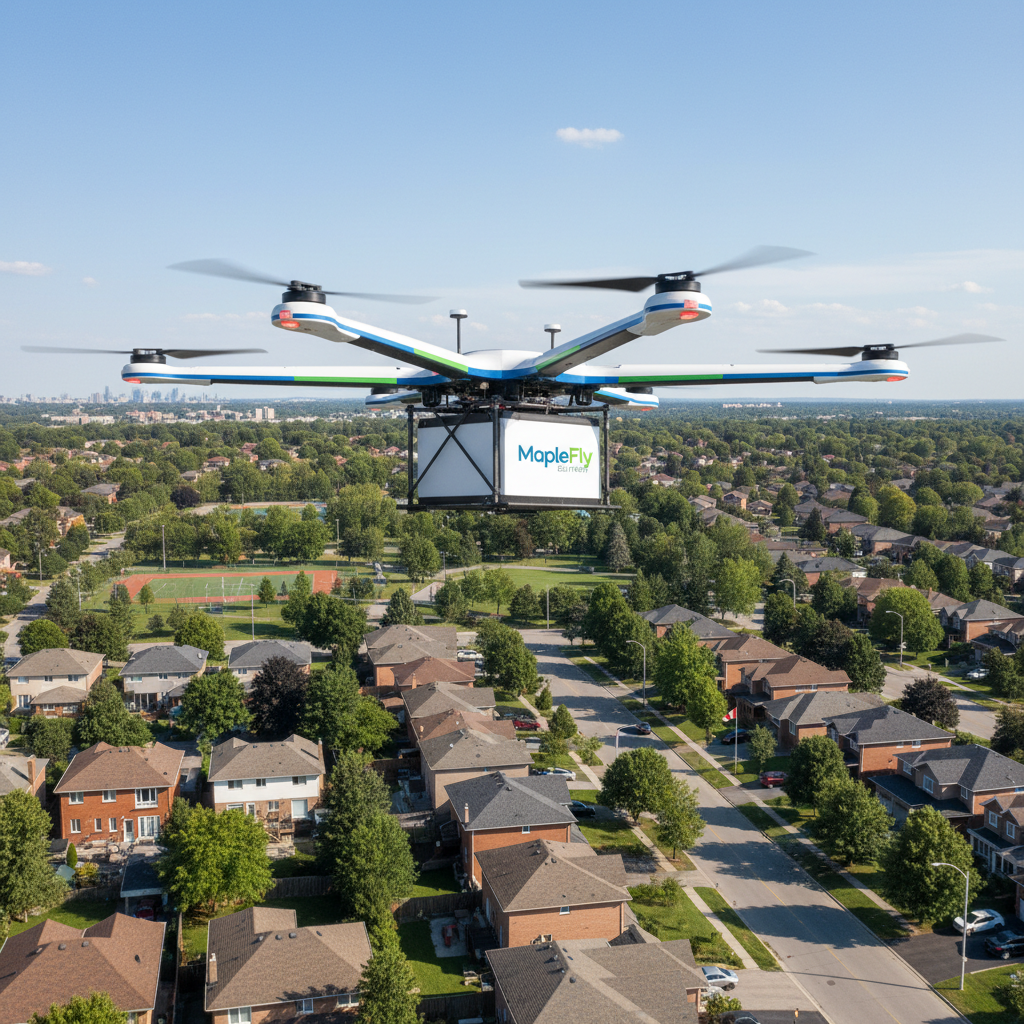
Amazon’s drones are electric, secure, effective, and carry small packages weighing a maximum of five pounds. With the potential to deliver within 30 minutes or less, these drones will collect products directly from nearby fulfillment centers and deliver them directly to consumers’ doorsteps.
Unencumbered by road topology or traffic congestion, drones are free to operate. They deliver products in regulated airspace aided by advanced GPS and obstacle-detection sensors. That equates to faster delivery timeframes—especially in areas that might have been out-of-bounds for conventional shipping procedures.
Why Canada Makes Sense for Drone Expansion
Canada’s strong infrastructure, technology-friendly policy, and growing online market place positioned it as the number one candidate for the next wave of Amazon drone trials. Its provinces of Ontario, British Columbia, and Alberta already have a stable system of Amazon fulfillment centers, making it an easy incorporation of drone service into current logistics.
In addition, Canadian regulators have been open to the development of drone technology for commercial and public service uses. With open airspace management and robust safety focus, Canada provides a safe foundation for Amazon to test and develop its drone delivery business.
Benefits for Consumers and Businesses
One of the greatest advantages of drone delivery is speed. In most of Canada, and especially rural or semi-rural regions, packages may take days to deliver due to large distances traveled and limited access routes. Drones cut out that delay, offering same-day—or even same-hour—delivery for eligible orders.
This provides new possibilities for small businesses. Those sellers who partner with Amazon can deliver their products to customers more quickly, restock more rapidly, and better manage shipping costs. The faster turnaround time might lead to greater customer satisfaction and sales.
Convenience-seeking consumers, however, enjoy the benefit of instant access to daily products—ranging from household supplies and gadgets to over-the-counter drugs and pet food. In times of crisis or extreme weather, instant service can be a lifesaver.
Saving Costs and The Environment
Other than being quicker, Amazon’s drone delivery initiative has the potential to be less expensive for shipping. Traditional delivery employs gas-hog trucks, multiple distribution centers, and human logistical chains. Drones, being electrically powered and direct-to-door, truncate multiple of these steps.
This translates into cost savings for Amazon and perhaps even for consumers.
Environmentally, the program can also reduce carbon footprints. Amazon has already committed to achieving net-zero carbon by 2040, and electric drones are ideally part of that vision. With the removal of trucks from service, especially for local pickup and delivery, Amazon lessens its eco-footprint—something that highly resonates with Canadian consumers concerned about sustainability.
Challenges and Considerations
While the potential is exciting, the implementation of drone delivery will not be without issues. Weather is Canada’s biggest worry. Steady rains and snow, coupled with thick winds, could hinder flight schedules or restrict drone operations in certain seasons or regions.
Infrastructure also matters. To make drone delivery scalable across the country, Amazon must work closely with local governments, aviation regulators, and city planners. There need to be launchpads, landing zones, and safety measures in communities before drones can become a common part of the delivery system.
Security and privacy will also be on the table. Canadians must feel confident that their homes are not under surveillance and that their packages are being delivered responsibly and safely.
What the Future Looks Like
As Amazon continues to pilot and deploy its drone delivery program in Canada, we can expect a gradual rollout starting in urban areas and spreading outwards to smaller towns. Eventually, drone delivery may be as normal as grabbing a package from a delivery truck.
Other retailers will likely do the same. If the model is successful, be on the lookout for food delivery chains, pharmacies, and other local retailers considering similar drone-based approaches. By doing so, Amazon isn’t merely revolutionizing its own logistics—it’s helping to redefine the future of delivery for the entire nation.
Conclusion: A Skyward Leap for Canadian Logistics
Amazon’s extension of drone delivery to Canada is not a business marker—it’s a paradigm for logistics, technology, and customer experience. By bridging the gap between speed and efficiency, Amazon is setting a new marker for what delivery in the 21st century will look like.
As drones begin to take flight across Canadian skies, they bring with them the promise of faster service, lower costs, and smarter logistics. Whether you’re in downtown Montreal or a small town in the Yukon, the way packages arrive at your door is about to change—forever.