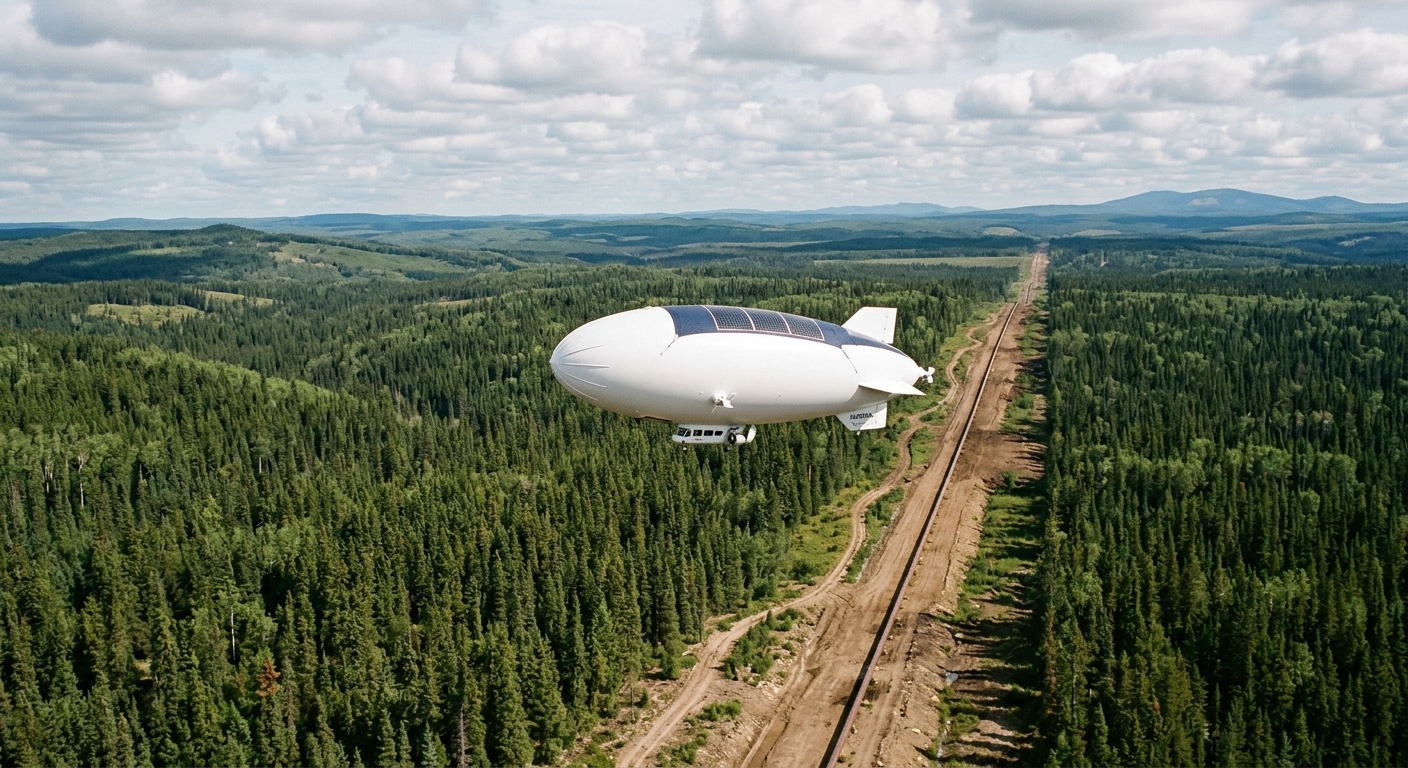
AI-generated illustration; not a photograph of the reported event.
- calendar_today October 12, 2026
Rare Airship Sight Captivates Central Alberta
Residents of Rocky Mountain House, Alberta, recently witnessed an unusual aerial visitor—a 20-metre-long solar-powered autonomous airship. The sighting, which sparked significant local curiosity, was part of a flight testing initiative to evaluate new methods for collecting aerial survey data, specifically for pipeline inspection in the region.
Flight Testing: A New Era in Pipeline Inspection
The project involved a collaboration between Cloudline, a South African aerospace company that developed the airship, and Canadian operational partner 3 Points in Space Media. Together with TC Energy, their team conducted a series of flights out of Rocky Mountain House Airport, aiming to demonstrate the potential for autonomous airships in surveying pipeline corridors.
Sean Adams, founder and CEO of 3 Points in Space Media, explained that the airship operates much like a helium party balloon but integrates modern autonomous control systems. Crews start by filling the airship’s envelope with helium and performing diagnostic checks. After pre-flight confirmations, the remotely piloted airship is launched for calibration runs before embarking on long-distance survey missions. One recent test completed a 100-kilometre flight run, showcasing the vehicle's endurance and automation.
Airship Technology Offers Heavier Payloads and Greater Range
Cloudline’s CEO, Spencer Horne, highlighted the airship’s payload advantage. With a capacity to carry up to 40 kilograms, it can transport larger camera and LiDAR sensors than most standard drones, enabling more comprehensive aerial surveys over substantial distances. Horne pointed out that, while conventional drones can lift increased payloads, their range is limited at maximum capacity, a limitation the autonomous airship overcomes.
Traditionally, energy companies have relied on crewed aircraft or smaller drones for monitoring pipelines and infrastructure. According to Joe Zhou, TC Energy's vice-president of pipeline integrity, this new approach holds the potential to collect multiple types of data in a single quieter flight, broadening opportunities for remote monitoring and inspection.
Challenges and Innovations in Cold Weather Testing
While celebrating the airship’s successes, the flight team also acknowledged its limitations in the face of severe cold and unpredictable weather. Adams noted that conventional crewed aircraft are more robust under such conditions. As part of ongoing development, upcoming trials will focus on cold weather testing in Northern Ontario to enhance the airship’s operational reliability for sub-zero and Arctic environments.
Honouring Aviation’s Past While Looking Ahead
For Michael Adams, vice-president of research and development at 3 Points in Space Media, flying the airship means reviving a form of aviation that lost prominence after the 1930s Hindenburg disaster. To bridge past and present, he attached a swatch of fabric from the Graf Zeppelin—a historic airship that completed the first commercial transatlantic passenger flight in 1928—to the test payload, symbolizing the connection between early airship pioneers and today’s technological advances in airship technology.
Community Reaction and Looking Forward
The presence of the airship drew excitement in Rocky Mountain House. Local Mayor Shane Boniface remarked that the community generated more online engagement for the airship trials than even a recent tornado. Although Cloudline operates airships internationally, this was a rare instance of such autonomous airship technology being tested in Canadian airspace. With future plans for challenging weather trials in store, the team hopes to bring further advancements in pipeline inspection and aerial data collection using modern airships.
Source: cbc.ca.