- calendar_today August 15, 2025
From Arthur C. Clarke to Camp Horror: The Journey of Species
Michael Madsen, the charismatic actor with a gravelly voice and rugged presence that punctuated many of our favorite movies — Reservoir Dogs, Kill Bill, Donnie Brasco — died earlier this month, leaving behind a long legacy of fan-favorite roles and movies that will live on for years. Madsen had a wide-ranging career, but the one film that deserves a fond look back as we remember his work isn’t one of the above. It’s the 1995 sci-fi action horror film Species, which is celebrating its 30th anniversary.
Species would be the first outing for screenwriter J. F. Lawton, who took to heart a decade-old article from Arthur C. Clarke that theorized that extraterrestrials had not visited Earth. Clarke’s reasoning: the energy required to travel at faster-than-light speeds is not available to us, and may not be available to anyone ever, making it nigh-impossible for an alien race to traverse the vast distances between stars. But what if, instead of a ship, contact was made with a way to engineer an organic species? In the film, it’s a way to create a mix of human and alien DNA — an invasive force that’s uncontainable, and exceedingly deadly.
Directed by Roger Donaldson (No Way Out, The Bounty), Species put a sci-fi twist on horror classics like The Blob. After two transmissions from space are received by the U.S. government (one contains the plans for a clean fuel source, the other has exact instructions on how to splice alien DNA with human DNA, naturally the government does it), a hybrid human/alien is born and placed under the care of Dr. Xavier Fitch (Ben Kingsley). The creation of Sil (Michelle Williams) was designed to make a product to take over the world, and was expected to be a tame organism to study. But Sil is something else entirely.
Sil matures quickly. By the time the three-month experiment is over, she’s the age and build of a 12-year-old girl, but she’s not behaving like a typical child. She has violent nightmares, and soon signs begin to point to the obvious: Sil is not going to be as easily controlled as her creators think she will be. When Fitch decides to end the project by pumping cyanide into Sil’s holding cell, she kills him by escaping from the cell.
A team of professionals is called in to hunt her down. They consist of Fitch’s cohort Preston Lennox (Michael Madsen), a black ops mercenary; Dr. Laura Baker (Marg Helgenberger), a molecular biologist; Dr. Stephen Arden (Alfred Molina), an anthropologist; and Dan Smithson (Forest Whitaker), a moody empath who can feel Sil’s pain. Tracking the runaway “experiment” across the country, the team ends up in Los Angeles, where a fully-grown Sil, now played by Natasha Henstridge, is on the hunt for a mate and a way to reproduce. She’s perceptive, she’s learned to change her form, and she’s going to do whatever is necessary to do that. Her targets are whoever she feels like hunting — from a train tramp, to a nightclub victim, to a former lover, they pile up as the clock ticks to stop her from beingget her from reproducing. If Sil has offspring, they’ll be just as likely to reproduce, and the world will be overrun with them.
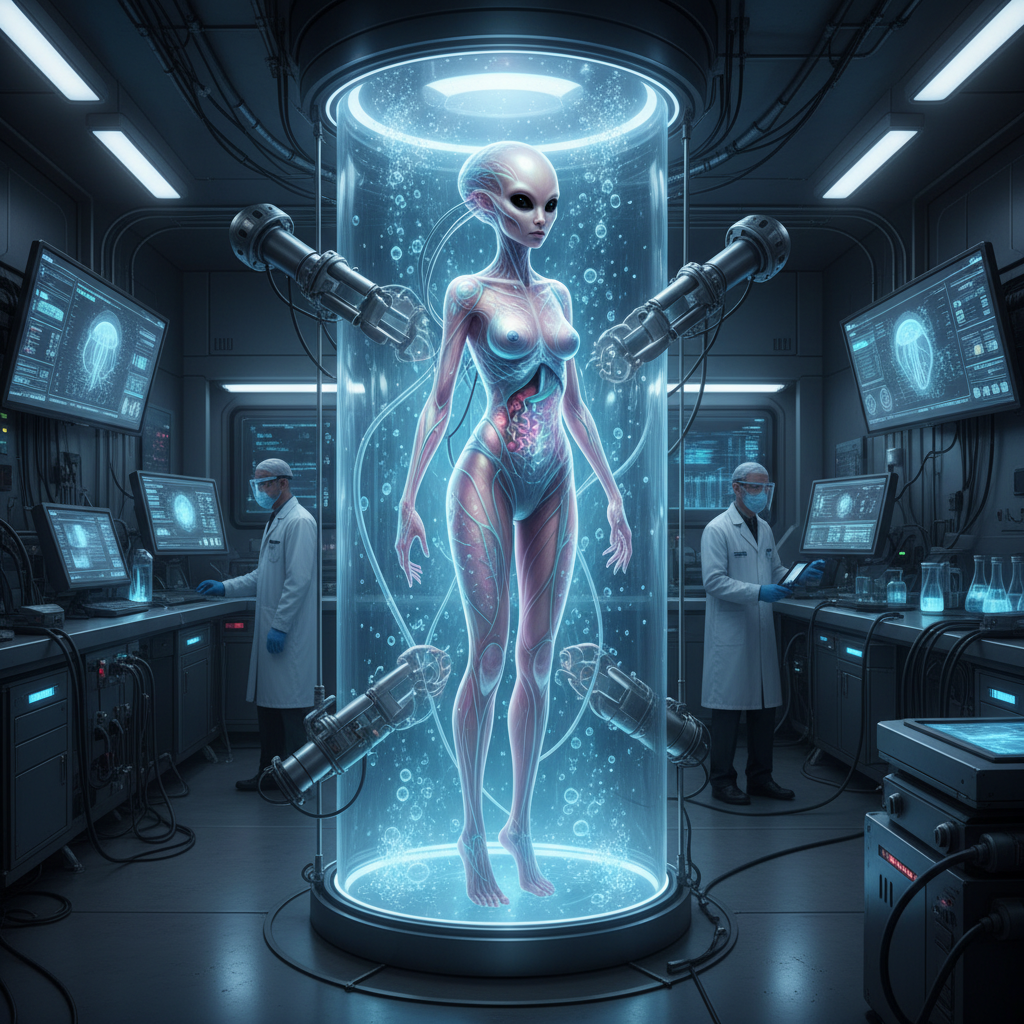
The look of Sil herself was created by H.R. Giger, the surrealist artist and filmmaker who became famous for his work on Alien. Giger said that Sil was designed to be “a kind of aesthetic warrior, also sensual and deadly.” Sil’s final form is ethereal, with translucent skin described as “like a glass body, but with carbon inside.” Giger designed several different stages of alien evolution for Sil, from fetus to adult, but due to budget and special effects restraints, Sil has a cocoon that she goes into to morph into her final form, and the maternal alien that the characters face in the end.
Giger was not pleased with Species, saying it was too similar to his work on Alien (specifically Alien 3), with a mix of Terminator 2. He thought the “punching tongue” and infamous birth scene were in direct reference to the Alien “chestburster” scene and that the design elements were copied from his Alien work. Giger had a clause in his contract that gave him input into the creature’s “violent death,” and so he insisted Sil be killed by a bullet to the head instead of a torrent of fire from flame-throwers.
Species was released in October 1995, and although it was a hit with audiences (generating more than $113 million at the box office against a budget of $60 million), it was not a critical success. The dialogue was weak, and many of the characters felt paper-thin. Kingsley’s Fitch is a largely amoral character who struggles to come across as charismatic or even good at his job. Whitaker’s empath has little to do besides wander the hallways mouthing some variations on “oh, that’s interesting.” Fitch, Arden, and Dr. Baker trade barbs and innuendo throughout, but the themes — the bioethics, alien contact, maternal instinct — never play out the way they seem to set up.
Species is a reminder of a time when big-budget SFF was less interested in heavy themes or fully realized characters than style and pure entertainment value. But there’s also something oddly endearing about Species for all its faults. Feldman’s screenwriting is based on that old Clarke article, and his imagining of what it would mean to come into contact with a hybrid human/alien species that was created to propagate itself and take over Earth is curious, even three decades later. Between Henstridge’s haunting performance, Michael Madsen’s gravelly dialogue, and Giger’s unforgettable design work, Species is a reminder of 1990s science fiction for better and for worse. But for a look back at a time capsule of style and genre, it’s a lot of fun.
Three decades later, Species serves as a time capsule of what science fiction looked like when style sometimes outshone substance—and of the unexpected, unforgettable roles that defined actors like Michael Madsen along the way.