- calendar_today August 28, 2025
The Producers Behind the Music Phenomenon of KPop Demon Hunters
The hyperanimated K-pop crossover is a “good opportunity to meet K-pop fans in the West.” The 25-minute “short film” was released by Netflix in June, where it has quickly become a phenomenon. In under two weeks, KPop Demon Hunters has been streamed over 33 million times, breaking into Netflix’s global top 10 in 93 countries. It is now ranked number two overall on Netflix’s list of “most popular around the world.” Fan art is already proliferating online, and calls for a sequel are accumulating with each new viewing.
KPop Demon Hunters is more than an online talking point; it is a chart-busting success story. Since its release on 20 June, the soundtrack has taken over real-life music charts. The film’s two main bands, the all-female righteous group Huntr/x and their antivillain counterparts Saja Boys, have topped the iTunes and Billboard album charts. A total of seven film songs have made the Billboard Hot 100, and in the US, they occupy positions one and two on the Spotify charts — an unprecedented feat for virtual idols.
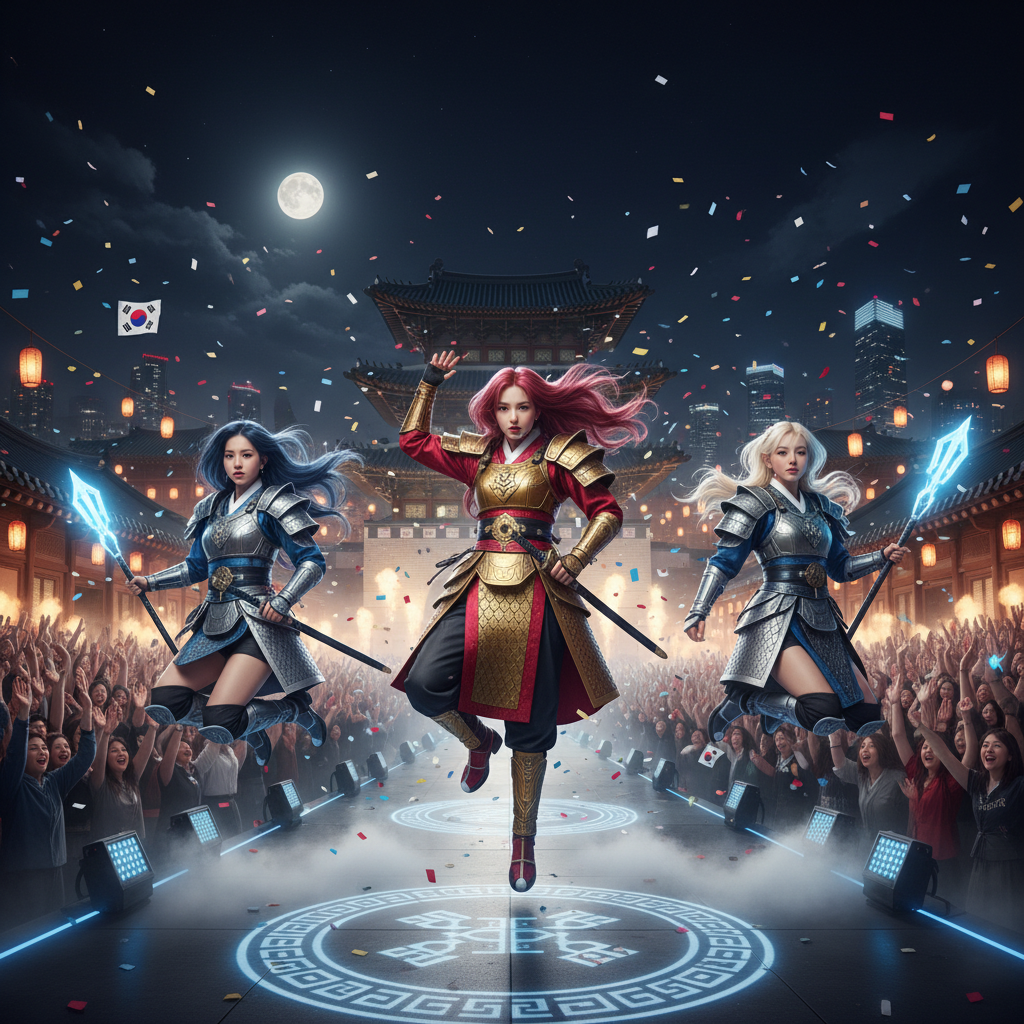
The Billboard-charting battle is about a fight to the death. The three Huntr/x members are global superstars who spend most of the movie fighting demons. Rumi, Mira, and Zoey must hide their true identities from the world while saving it in their spare time. The characters are shown on a mystical journey against a backdrop of impressive stage performances, slick action sequences, and a simple narrative that explores friendship, trust, and remaining true to oneself. Comedy, emotional scenes, and a dollop of fantasy are just some of the ingredients that have made KPop Demon Hunters a hit with viewers across cultures.
Visually and narratively, KPop Demon Hunters has succeeded in its appeal to the general public. But, according to media experts, it is the soundtrack that turned the movie into a chart topper. Co-director Maggie Kang is a Korean-Canadian who grew up adoring K-pop idols. In KPop Demon Hunters, music is, of course, a core theme. K-pop idols in the film don’t just sing to the public; they also fight and destroy demons with music. It’s a narrative decision that, according to the filmmakers, serves to organically integrate music into the plot. “The songs are so much a part of the storyline that you don’t feel like they’re interrupting the movie to drop a track,” says Lashai Ben Salmi, a community leader focused on the Korean community in Europe. “It gives the film a surprising level of maturity.”
Kang and her directorial partner Chris Appelhans, based in Los Angeles, chose a Korean label and invited some of the industry’s most respected producers and musicians to work on the film. Teddy Park, who works with the South Korean girl group Blackpink, and Lindgren, a Grammy Award-winning producer whose works include music for BTS and TWICE, co-wrote the soundtrack. A series of original songswwascreated that matched or exceeded the quality of real K-pop records and crossed over into non-K-pop audiences.
Amanda Golka, a Los Angeles-based content creator with large followings on TikTok and Instagram, is an example of how the K-pop film was able to attract a previously non-K-pop audience. “I am not much of a K-pop watcher, but I think the soundtrack is on fire,” Golka says. “I have been blasting the soundtrack from Spotify every time I’m in the car. I found it rescinating to see how much of a universal language music can be.”
Cultural tradition or an international fad?
Western countries like the US have already made K-pop, K-dramas, and Korean movies popular in mainstream media. KPop Demon Hunters exceeds this norm by integrating Korean daily life scenes into the film. Korean viewers are served a virtual meal made by their dearest K-pop idols while sitting at a Korean-style table in the movie. Real scenes from around the Korean capital, Seoul, can be found in historical locations such as ancient city walls, Hanuiwon medical clinic buildings, public bathhouses, and Namsan Tower. The film team has also broken away from the cliche in some scenes.
Director Kang is from Los Angeles, but her partner, director Chris Appelhans, says he spent a month in Korea earlier in the year to “make sure the Korean language sounded and looked and felt accurate for the film.” The crew went to folk villages, took Myeongdong street photos, and got immersed in Korean clothes and culture. The animation itself was shot through with fine details. Even though the characters are speaking English in the finished film, the lip movements for each syllable in the words they are singing are Korean. Korean speakers feel their body language and voice reactions. Scenes of Korean words or K-pop lyrics are also scattered throughout.
Fan culture, a major component of K-pop, is also one of the best parts of KPop Demon Hunters. Meet-and-greets, light sticks, K-pop KALGUNMU (synchro), and Korean banners are all on display. This attention to detail also extends to the characters’ identities. It represents K-pop in its entirety, not just one idol group or period, making it easier for new fans to get into the film. Longtime fans may recognize some Easter eggs hidden throughout the film.
Another feature of the work is its blending of traditional Korean elements into its high-flying fantasy action. The martial arts the three girls use, especially when they wield swords and fans, are reminiscent of Mudang, the shamans. On the other hand, Kaja Boys’ costumes and personal symbols are reminiscent of the Grim Reaper in Korean folklore. The various folk symbols in the film, such as Dangsan trees, Dokkaebi goblins, and even folk-inspired minion mascots like Derpy the tiger and Sussy the magpie, are both guardians and bearers of good fortune.