- calendar_today August 16, 2025
.
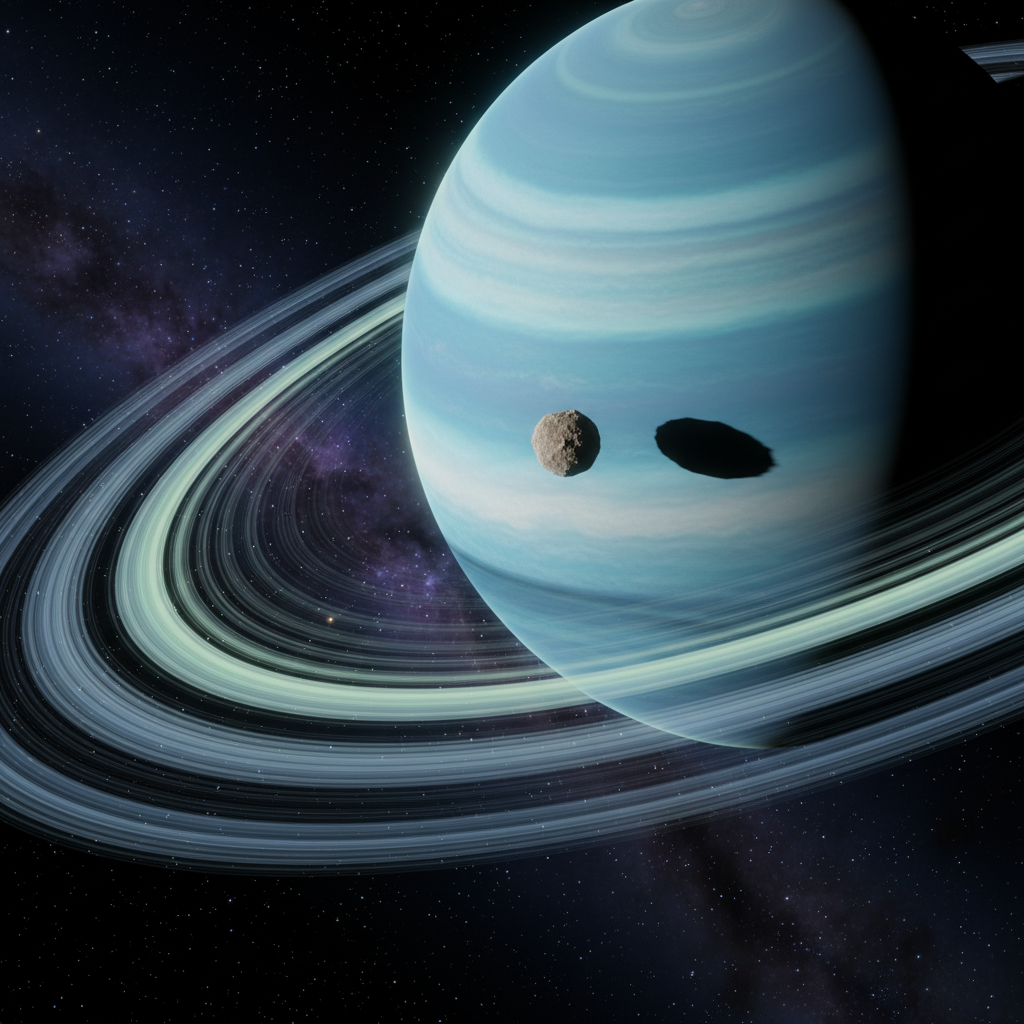
NASA’s James Webb Space Telescope has detected a previously unknown moon orbiting Uranus, increasing the number of moons around the ice giant planet to 29 and providing an exciting new target for study. Researchers suspect that additional small moons remain hidden in Uranus’ rings.
Webb revealed the faint satellite on Feb. 2 with a series of 40-minute long-exposure images taken with the telescope’s Near-Infrared Camera. The small moon is just 6 miles (10 km) across. It’s one of the smallest natural satellites ever discovered around Uranus. Its dimness and Uranus’ bright rings almost certainly hid it from view for previous spacecraft and telescopes. NASA’s Voyager 2 even missed it during its iconic Uranus flyby more than 38 years ago.
“This is a small moon but a significant discovery,” said lead scientist Maryame El Moutamid of the Southwest Research Institute’s Solar System Science and Exploration Division in Boulder, Colo. El Moutamid is also a principal investigator for a Webb program that is dedicated to exploring Uranus’ rings and inner moons. “Webb is doing for the outer solar system what the Hubble Space Telescope and ground-based telescopes have been doing for the inner solar system for decades,” she said.
Webb’s observations of Uranus are already yielding new insights about the planet’s rings, weather, and atmosphere. S/2025 U1, as the new moon is temporarily known, orbits the planet at a distance of about 35,000 miles (56,000 km) from Uranus’ center. It follows a nearly circular orbit that lies within the planet’s equatorial plane, just between the known moons Ophelia on the outside and Bianca on the inside. Its orbit suggests the moon formed in its current neighborhood.
Astronomers had to overcome the challenge of distinguishing the tiny, dark, and fast-moving moon from the bright glare of Uranus and its rings. Webb’s infrared sensitivity provided the key. This is the first time an instrument on Webb’s fine guidance sensor has discovered an astronomical object on its own.
The new moon becomes Uranus’ 29th known satellite. Uranus already has five big moons — Miranda, Ariel, Umbriel, Titania, and Oberon, which are visible in the full image as well as with Hubble. The newfound world is the 14th small moon in Uranus’ inner system. Scientists have found no other planet with as many small inner moons as Uranus has and packed so closely together. The satellites orbit so close to one another that their orbits nearly cross. Somehow, they all avoid colliding and remain locked in stable orbits, possibly acting as shepherds to Uranus’ narrow rings.
“I would call this a very exciting discovery,” said Scott Sheppard, an astronomer at the Carnegie Institution for Science who was not involved in the new study but co-discovered a Uranus moon in 2024. “The object is very close to Uranus’ inner ring system, which makes it especially interesting,” he said. “The reason we can even detect this small moon is due to Webb’s exquisite sensitivity.”
Co-discoverer and co-principal investigator Matthew Tiscareno of the SETI Institute said the discovery highlights the blurry distinction between Uranus’ moons and its rings. “Their complex inter-relationships hint at a chaotic history,” he said in a statement. The newly discovered moon is even smaller and fainter than the smallest known Uranian inner moons. It may point to the existence of additional hidden satellites.
For the most part, Uranus’ moons have come into view over time. Before Voyager 2’s historic flyby in 1986, only the largest five had been discovered, with the first, discovered as far back as 1787. Voyager 2 discovered another 10, measuring between 16 and 96 miles (26 and 154 km) in diameter. Later, ground-based telescopes and the Hubble Space Telescope found another 13 small moons, each between 8 and 10 miles (12 and 16 km) across and so dark that they are likely as dark as asphalt. Inner moons have icy and rocky compositions. The satellites found farther away from the planet beyond Oberon are thought to be captured asteroids.
The future of Uranus exploration is bright, at least in terms of missions. A planetary decadal survey published in 2022 by the National Academies of Sciences, Engineering, and Medicine recommended a Uranus Orbiter and Probe mission as NASA’s next large planetary effort. The mission could launch in the early 2030s, but funding is uncertain amid a budget fight. If NASA decides to move forward with the mission, it would examine Uranus’ strange sideways rotation and complex magnetic field, atmospheric dynamics, interior structure, icy ocean worlds among the moons, and more.
Sheppard believes there are more moons, likely only a few kilometers across, still to be discovered. Either Webb’s long-exposure images or a spacecraft mission would be required. El Moutamid and her team will refine the object’s orbit with future observations and continue to hunt for hidden moons around Uranus.
“Discovering a new moon around Uranus helps scientists better understand how its strange system formed, sheds light on its rings, and prepares us for future missions like NASA’s Uranus Orbiter and Probe,” El Moutamid said.