- calendar_today August 7, 2025
.
Ukrainian President Volodymyr Zelenskyy described Monday’s phone call with U.S. President Donald Trump on security guarantees as “good,” as the four-year war with Russia rages on.
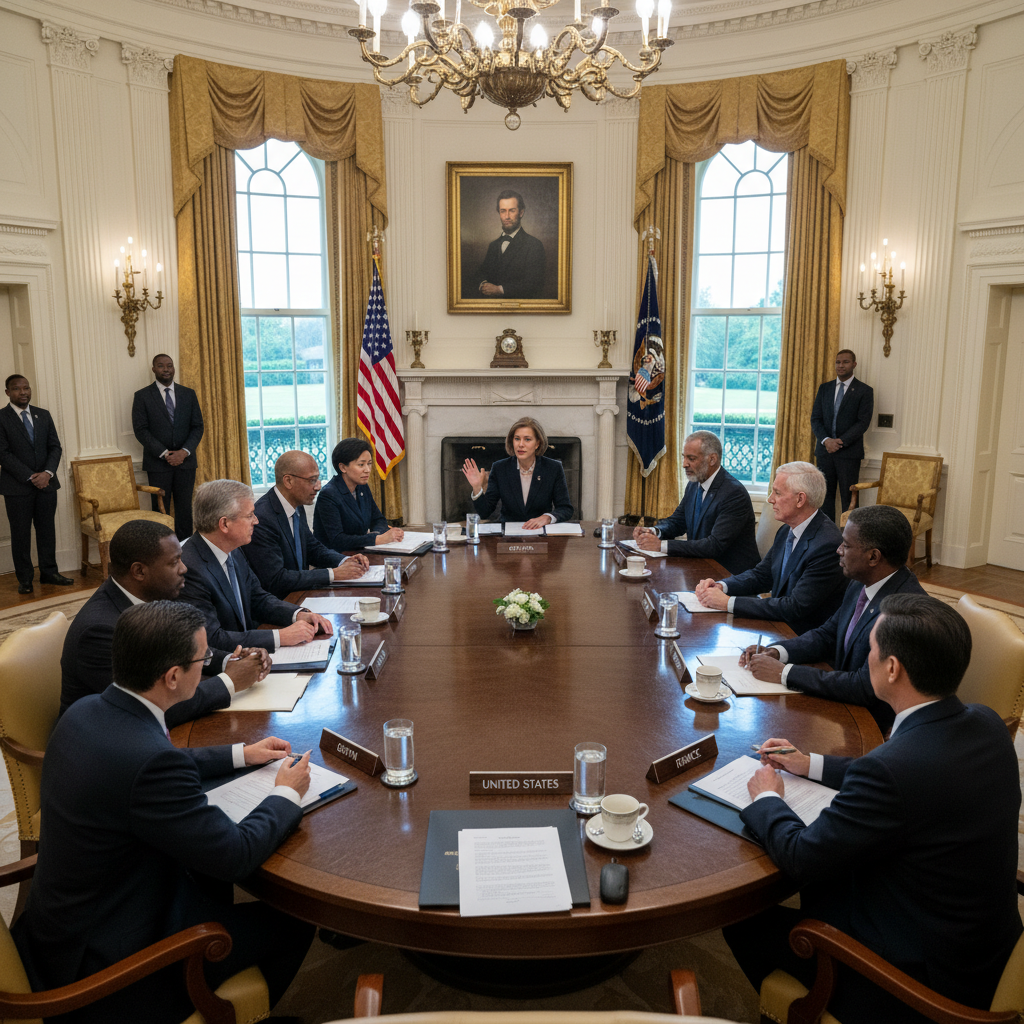
In an appearance at the White House alongside Trump and other European leaders, Zelenskyy said that Ukraine’s future hinged on its security guarantees. “The first one is security guarantees. And we are very happy with President [Trump], that all the leaders are here, and security in Ukraine depends on the United States and European countries,” Zelenskyy said. “So we are very much impressed, because without the guarantees and security, and no perspectives for our existence as an independent state.”
Trump, who also highlighted the need for security, pushed back by saying Europe should do more to provide security and that Ukraine cannot be rebuilt without a peace deal that includes a territorial swap. “We’re going to help them, and we’re going to make it very secure,” Trump said. “We also need to discuss the possible exchanges of territory, taking into consideration the current line of contact. That means the war zone, the war line center.”
The high-profile meeting in the White House illustrated the divide in Washington and Europe over providing more security guarantees to Ukraine and engaging with Russia on a negotiated peace. While Trump has maintained that territory should be swapped, Zelenskyy has consistently said Ukraine must retain its sovereignty and borders.
Sanctions, Ceasefire Discussion, NATO a Question
U.S. lawmakers discussed possible economic penalties against Russia and its trading partners while leaders in Washington discussed security guarantees. Senator Lindsey Graham, R-S.C., a close ally of Trump, also suggested the U.S. needs to move more aggressively against Russia’s financial institutions. “What I’m saying is that the longer this goes on, the more he [Putin] has got to know that if he does not make a reasonable decision to end this war, the American people are going to destroy the Russian economy,” Graham said on Fox News. Graham, who was in attendance for Monday’s meeting, said he was co-sponsoring a bill to give Trump up to a 500 percent tariff on countries that continued to trade with Russia.
The Trump administration has already demonstrated its ability to levy tariffs on Russia’s trading partners. In August, the president announced a 50 percent tariff on India in part due to its purchases of Russian oil. Graham floated the possibility of using a similar tactic against China, suggesting that economic pressure on Beijing could lead to a quicker end to the war. “The second most important person on the planet to end this war is President Xi in China,” Graham said.
In Europe, the European Union (EU) is in the process of putting together its 19th package of sanctions against Moscow. The bloc is expected to present a new package later this month to punish Russia for its war in Ukraine. These are likely to include fresh measures on Russian energy revenues, banking, and the military-industrial complex, as well as a closing of some of the existing sanctions loopholes. After almost four years of unity, Russia is now the most sanctioned country in the world, more isolated than Iran, North Korea, or Venezuela.
Ceasefire was also raised during Monday’s meeting with European leaders, urging Trump to consider a temporary truce before more serious negotiations can take place. “If we can agree on something, it would be that before a ceasefire, the next meeting, there must not be,” German Chancellor Friedrich Merz told reporters in Washington. “The big problem is that one is building up one’s military forces all the time, and the other one as well, and that does not fit with an agreement,” Merz added. Trump dismissed the idea and said that several of the six agreements he claims to have brokered in recent months were done without a ceasefire. “You have a ceasefire, and they rebuild and rebuild and rebuild,” Trump said, while acknowledging that the benefit of a ceasefire would be to stop civilian deaths.
Finnish President Alexander Stubb also met with Trump at the White House. Stubb, who took office in March 2024, is one of Finland’s most Russia-skeptical leaders and has been outspoken about the Finnish president’s distrust of Putin’s commitment to a ceasefire. “We are against further escalation, but we cannot just trust the Russian president’s words not to attack again in Finland,” Stubb told reporters before the meeting, highlighting Finland’s 800-mile border with Russia. A close ally of Trump among European leaders, Stubb said of the White House summit, “I think if I look at the silver lining of where we stand right now, we found a solution in 1944, and I’m sure that we’ll be able to find a solution in 2025 to end Russia’s war of aggression.”
In addition to sanctions and a ceasefire, Trump has also been more explicit about his conditions for peace. The former president urged Ukraine to formally cede Crimea, which Russia annexed in 2014, and to abandon any plans of ever joining NATO. “President Zelenskyy of Ukraine can end the war with Russia almost immediately, if he wants to, or he can continue to fight,” Trump wrote. He placed the blame on former President Obama for “giving” Crimea to Russia without a fight more than a decade ago, and that “NO GOING INTO NATO BY UKRAINE” has to be a red line.
The divide between Zelenskyy’s push for long-term guarantees from the West and Trump’s emphasis on territorial and NATO concessions highlighted the disagreements in Washington and Europe on how to end the war in Ukraine. With the EU set to announce new sanctions against Russia and allies of Putin, tariff threats on the rise, and continued fighting on the ground, the path toward peace remains unclear and stuck between calls for compromise and solidarity.