- calendar_today August 14, 2025
.
After more than a year of month-over-month growth, US electric vehicle (EV) sales have started to shrink, and buyer interest has waned. Automakers that have seen customers walk away from their EVs, such as Genesis and Volvo, have moved to scale back their lineups in response.
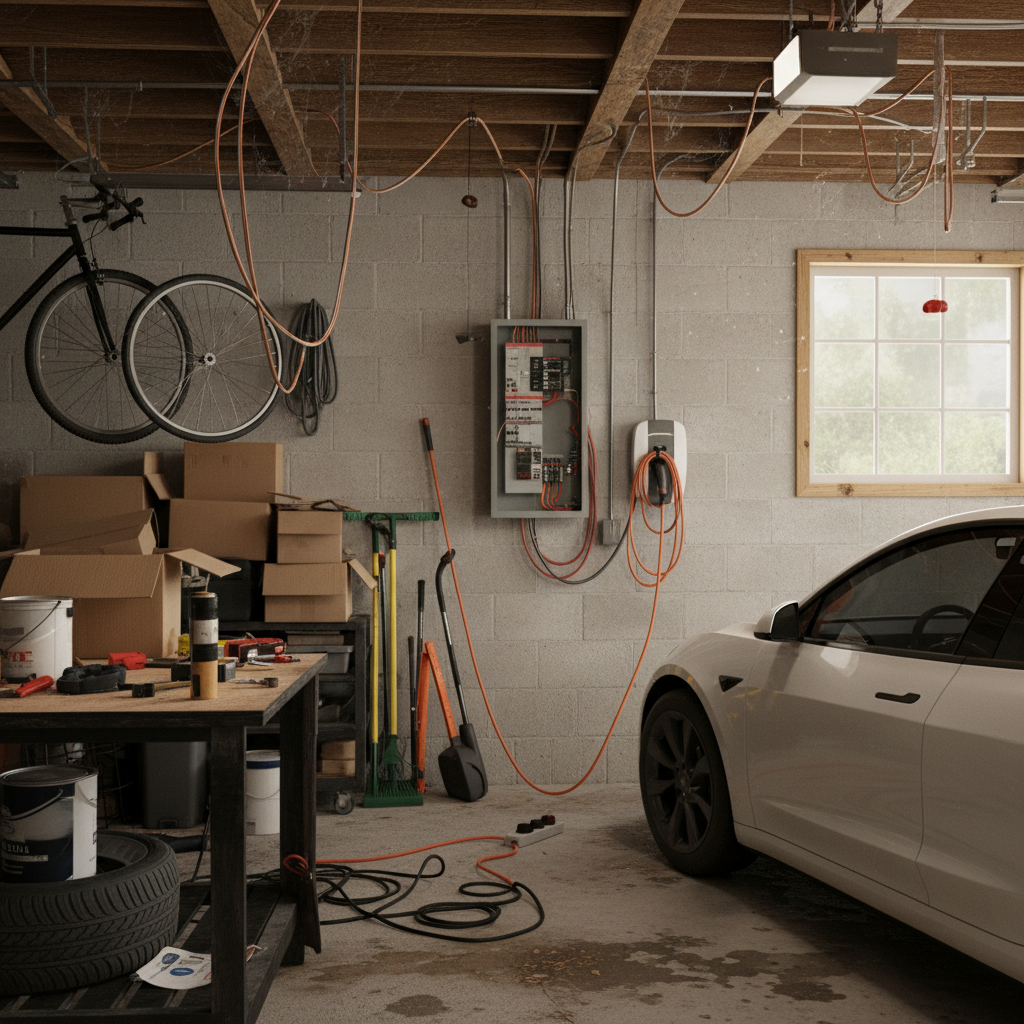
President Biden’s administration has not helped matters, either. It’s cut subsidies and even rolled back vehicle pollution rules, leaving fewer federal perks on the table for drivers. But Telemetry’s own research suggests that the real challenge to EV adoption may not be political at all. It may be hiding in US garages.
Doorsteps and Driveways
Customers frequently cite “charging anxiety” as the number one reason to reject electric cars, and surveys have long backed that up. Telemetry Vice President Sam Abuelsamid has taken a fresh look at the problem, however, and found that one factor in particular may have been flying under the radar.
Charging networks get the headlines, but the majority of charging still takes place at home. Roughly 80 percent of all EV charging happens with AC power, and most of that is at a single-family residence. The National Renewable Energy Laboratory (NREL) reports that 42 percent of homeowners already park within range of an outlet that can support level 2 charging (240 volts).
That percentage could jump to 68 percent, according to Abuelsamid, if home garage space were cleared and parking habits changed. “90 percent of all houses can add a 240 V outlet near where the car could be parked,” he said. “Parking behavior, namely whether homeowners use a private garage for parking or storage, will likely become a key factor in EV adoption.”
The number of households capable of charging EVs would leap from 31 million to over 50 million if garages were available for cars instead of clutter, Abuelsamid calculates. It would climb higher still, to more than 72 million, if we add in houses that could install new wiring. That’s far above even Telemetry’s most bullish EV projections for 2035, which see between 33 million and 57 million electric vehicles on US roads.
But having the capability to charge electric vehicles isn’t the same as being ready to install a charger. NREL found that nearly 34 million homes will need to pay for upgrades to support a level 2 charger, which requires at least 30 amps of power. These improvements, which can run from installing new wiring to replacing the entire electrical panel, can easily reach into the thousands of dollars.
If that’s true, it calls into question one of the major value propositions of EVs: long-term affordability. Adding in the cost of installing charging equipment at home pushes the total cost of ownership closer to, or possibly even above, a conventional gasoline-powered car.
Parking Lot Politics
For the 23 percent of US residents living in multifamily homes like apartments, condos, and townhouses, the barrier is even higher. In these locations, it’s typically the landlord, management company, or a cooperative board, rather than the car owner, who have the authority to install a charger. Individual EV drivers in these residences have very little control.
The financial burden is greater, too. Charging a pair of residents at a co-op building, for instance, might require upgrading the electrical panel first, a process that can run into the millions of dollars. Wiring to a distant parking spot piles on the cost. And unlike those with single-family residences, residents of multifamily buildings are often not eligible for municipal or utility assistance for charging equipment.
Around 11 percent of the EVs on the road today are registered to residents in multifamily homes. Only one in nine of those homes has parking spots near enough to an outlet to make charging feasible. State governments are mandating that 20–25 percent of parking spots be EV-ready in new constructions, but that’s not enough to make a difference on a national scale. Telemetry estimates that there will be between 6.7 million and 11.4 million charging-capable spaces in multifamily residences by 2035. It will still be insufficient to meet demand.
EV drivers will have to lean on public charging equipment, too. Telemetry’s analysis suggests that between 11.7 million and 14.3 million owners of single-family houses will use public chargers regularly by 2035. Another 7.8 million to 8.1 million EV owners who live in multifamily homes will also be reliant on public charging. It’s a total of between 19.5 million and 22.4 million EV drivers still dependent on public charging sites by 2035.
This dependence on public charging infrastructure raises yet more questions, however. Sufficient fast charging alone will require between 523,000 and 586,000 DC fast chargers across the nation. Throw in a projected need for another 1.5 million to 1.6 million level 2 chargers as well, and demand for public charging will require a substantial expansion of charging capacity in public and commercial parking spaces. That capacity is already under pressure. The country’s electric grid is struggling to keep up with new data centers coming online from hyperscale AI companies. Will the juice for charging be there, too?
There’s no doubting the enthusiasm for electric vehicles on the national stage, or even within Telemetry. But the road to EV adoption in the US may not be as clear as it seems from the outside. If millions of homes can, in theory, support electric vehicle charging, the cluttered state of garage space, the cost of electrical upgrades, and the challenge of multifamily living still present significant headwinds to EV take rates. It’s entirely possible that the number of charging outlets will fail to keep pace with the demand from electric vehicles by the end of the 2020s.
Until then, it seems that the future of EVs in America may hinge on as much on the state of homeowners’ garages as on the direction of federal policy or automakers’ decisions.